
The complete guide
Choosing a Teepee Tent with Fairy Lights: A Practical Buyer's Guide
The problem a teepee actually solves
Most children's bedrooms are shared territory. There is a bed, a wardrobe, a shelf of toys that belongs to everyone, and maybe a desk that a parent uses as much as the child does. What is often missing is a small patch of the room that is unmistakably theirs, with a door they control.
That is what a teepee does. It is not really about camping and it is not really a toy in the usual sense. It is a boundary. A child walks in, pulls the flap closed, and the rest of the house carries on at arm's length. Parents notice the effect fairly quickly. Children who were bouncing off the walls settle down. Children who struggle to wind down at bedtime get a halfway step between full play and lights out.
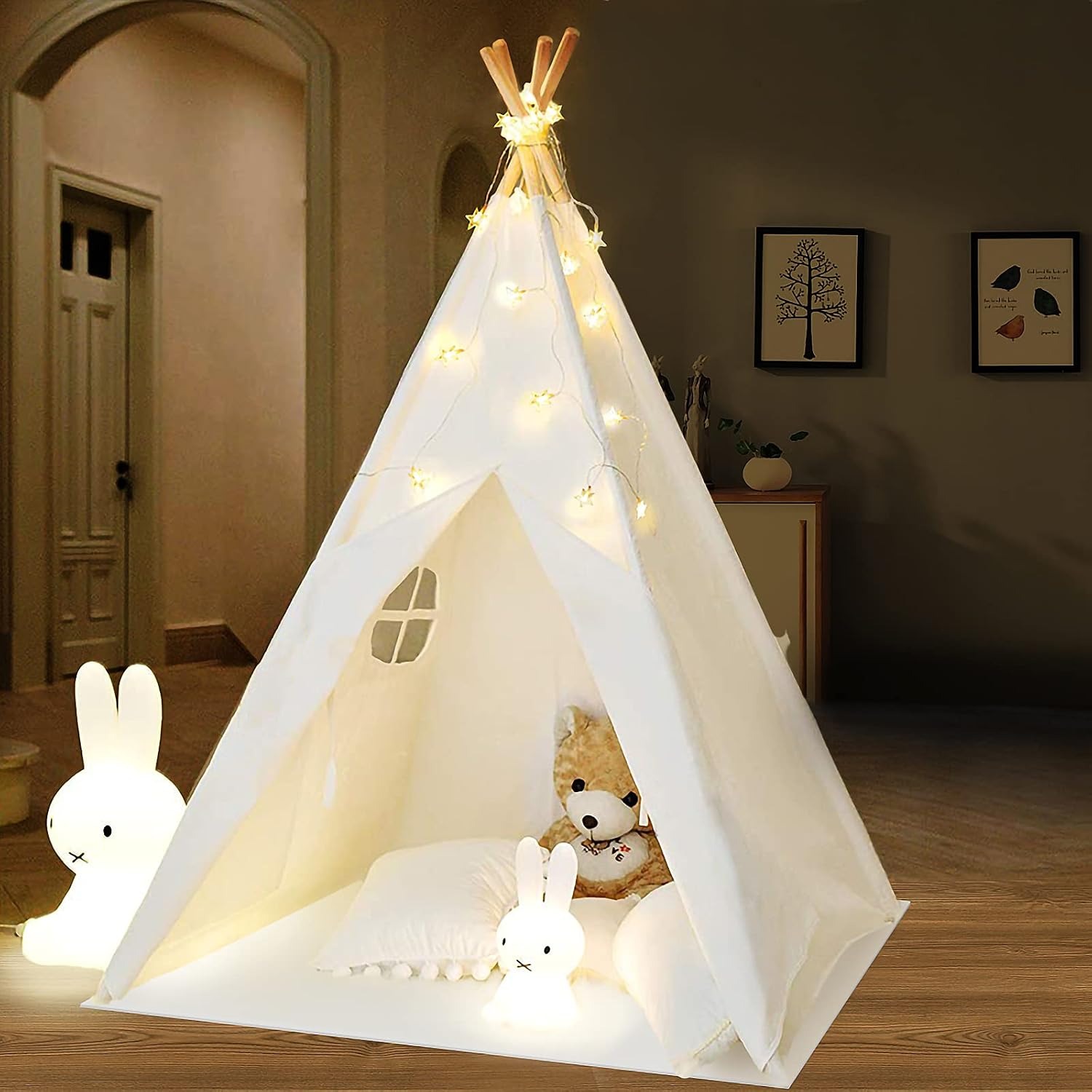
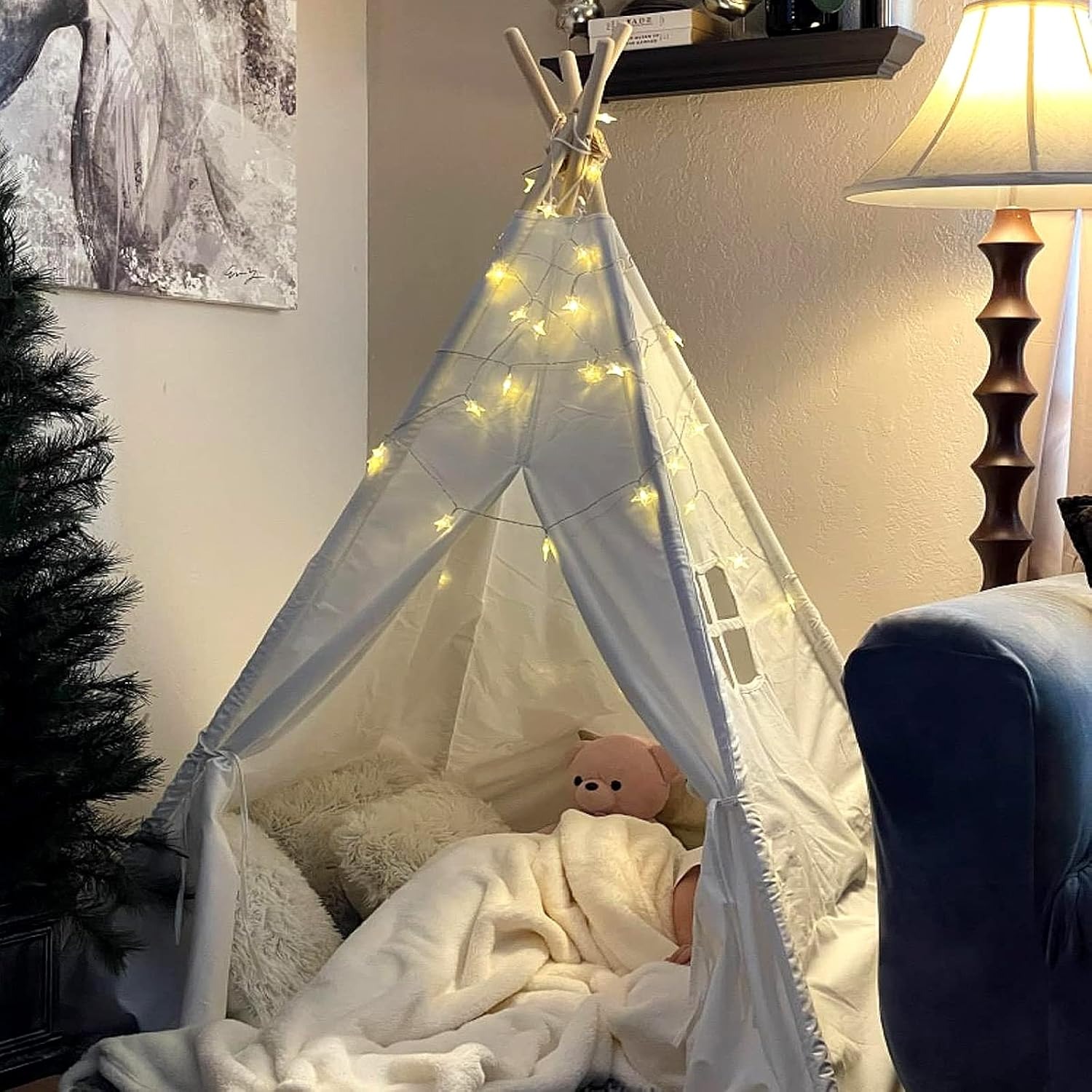
The fairy light is what turns a plain canvas structure into somewhere a child wants to be after dark. A soft glow inside a small enclosed space reads as safe and cosy to most children. That is why so many families end up using the teepee as a story spot rather than a play tent.
How this one is built
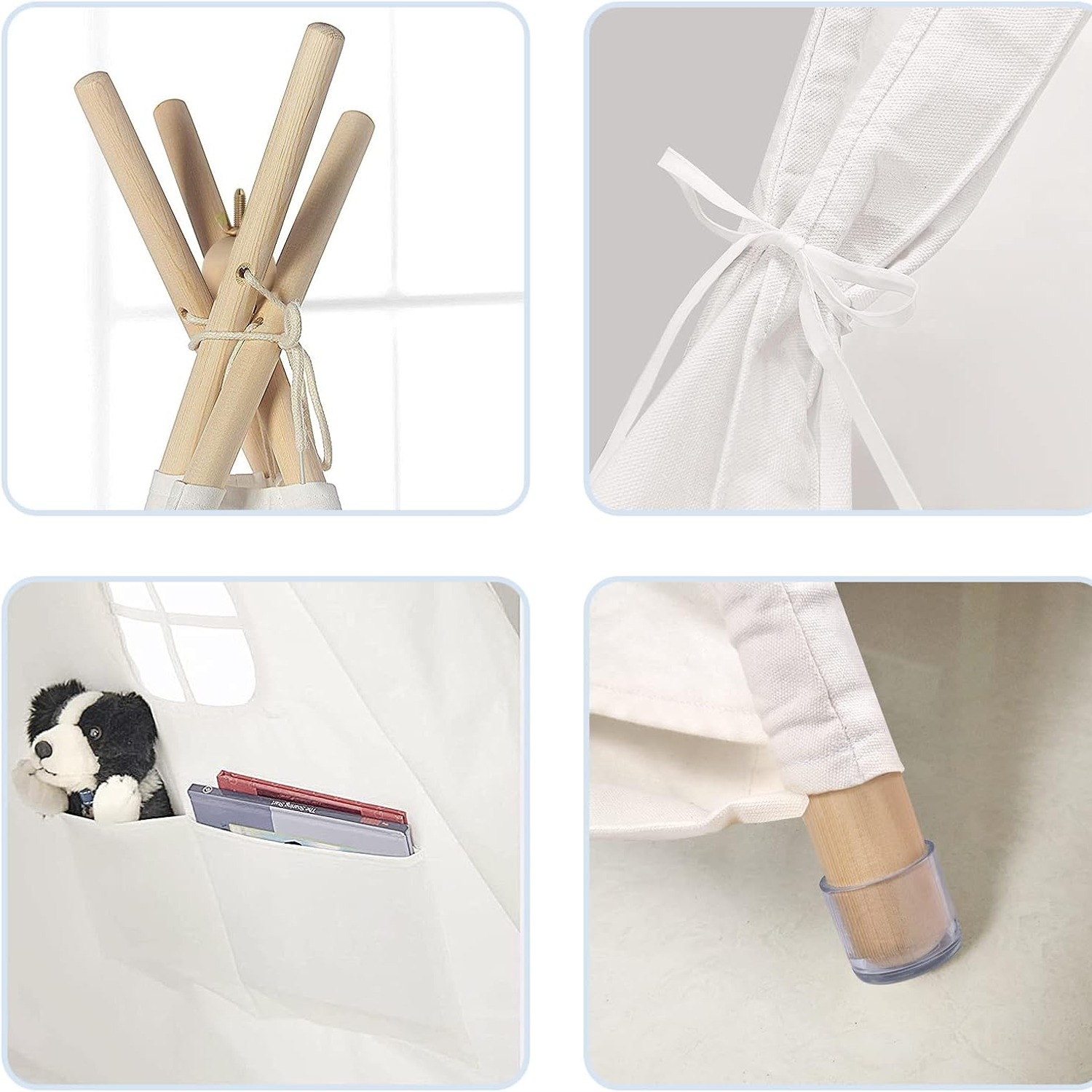
The structure is simple and it is simple on purpose. Four pine poles, sanded smooth, slide up from the base of the tent into sleeves sewn into the canvas panels. A plastic joint holds them together at the top. Because the poles live inside the fabric, there are no bare pole ends at child height and nothing obvious to tug loose during a game.
The canvas is cotton and it is left unpainted. That matters for two reasons. First, it means the tent looks calm in a bedroom rather than clashing with everything else. Second, plain cotton has a soft hand to it that children notice when they lean against it.
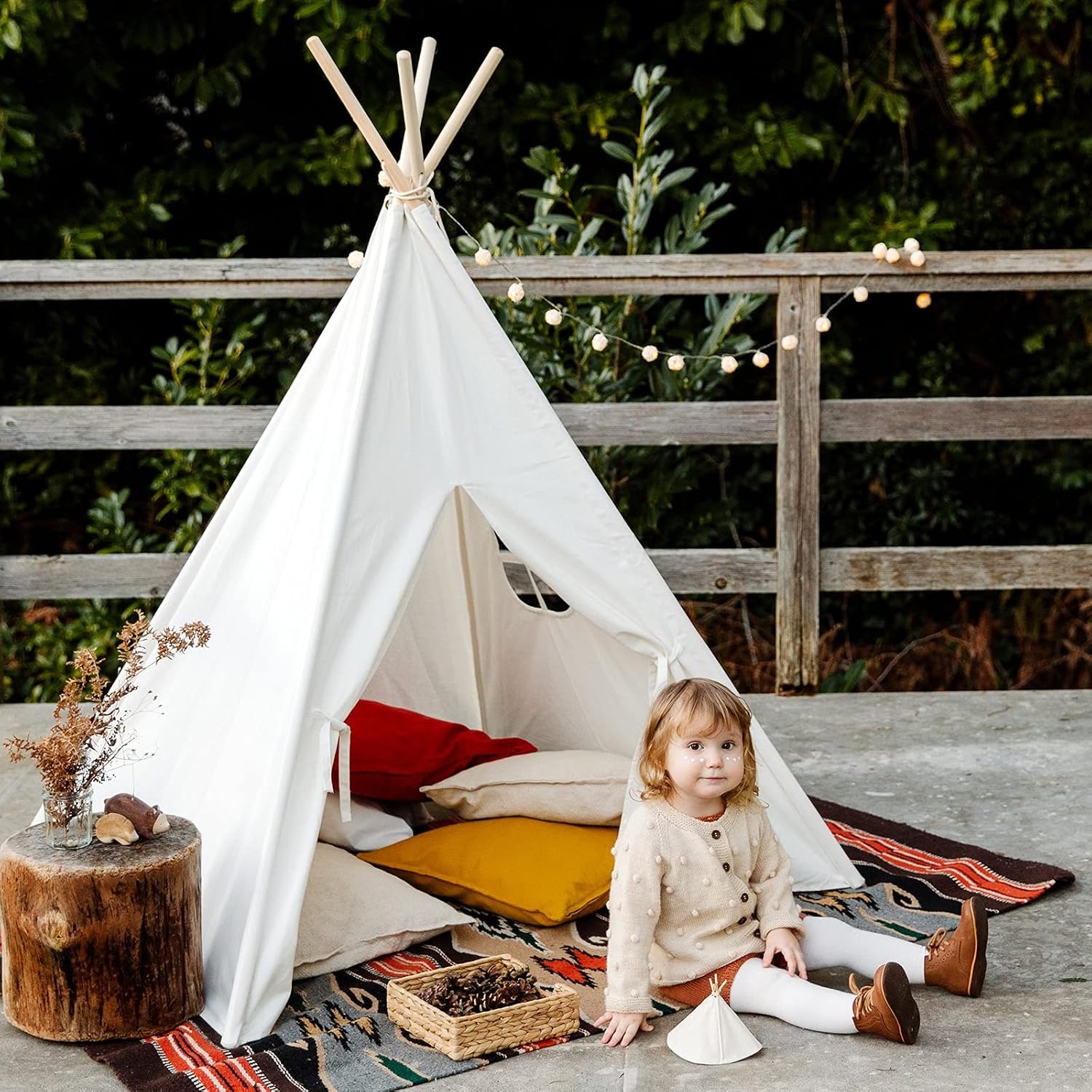
The front has a flap door. Tie it back and the tent is open and inviting. Drop it and your child has privacy. On the side there is a mesh window, which does more work than it looks like it should. It keeps air moving when the sun is on the room, and it lets you glance in to check on a quiet young child without opening everything up.
The string light comes in the box. It runs on batteries, which are not supplied, so grab a pack before you hand it over. Most people drape it along the poles or around the inside of the doorway.
Who it suits
The manufacturer gives a recommended age range of 36 months to 12 years. That is a wide window, and in practice the way the tent gets used changes a lot across it.
A three or four year old treats it as a den. It becomes a shop, a spaceship, a cave, whatever the game of the week requires. Toys migrate in and never quite come out. Around five to seven, it tends to shift towards a reading spot, especially once the string light goes on. Older children often keep it as a retreat, somewhere to take a book or a tablet and be left alone for twenty minutes.
It suits one child comfortably. Two small children can sit inside facing each other, and siblings often do, though it is a squeeze once they are both over about six. If you have three children who all want in at once, you are better off thinking of this as a one-at-a-time space with a rota.
It also suits adults who do not want a plastic playhouse dominating the living room. Cotton canvas and bare wood sit far more quietly in a shared space than moulded plastic in primary colours.
Measuring up before you buy
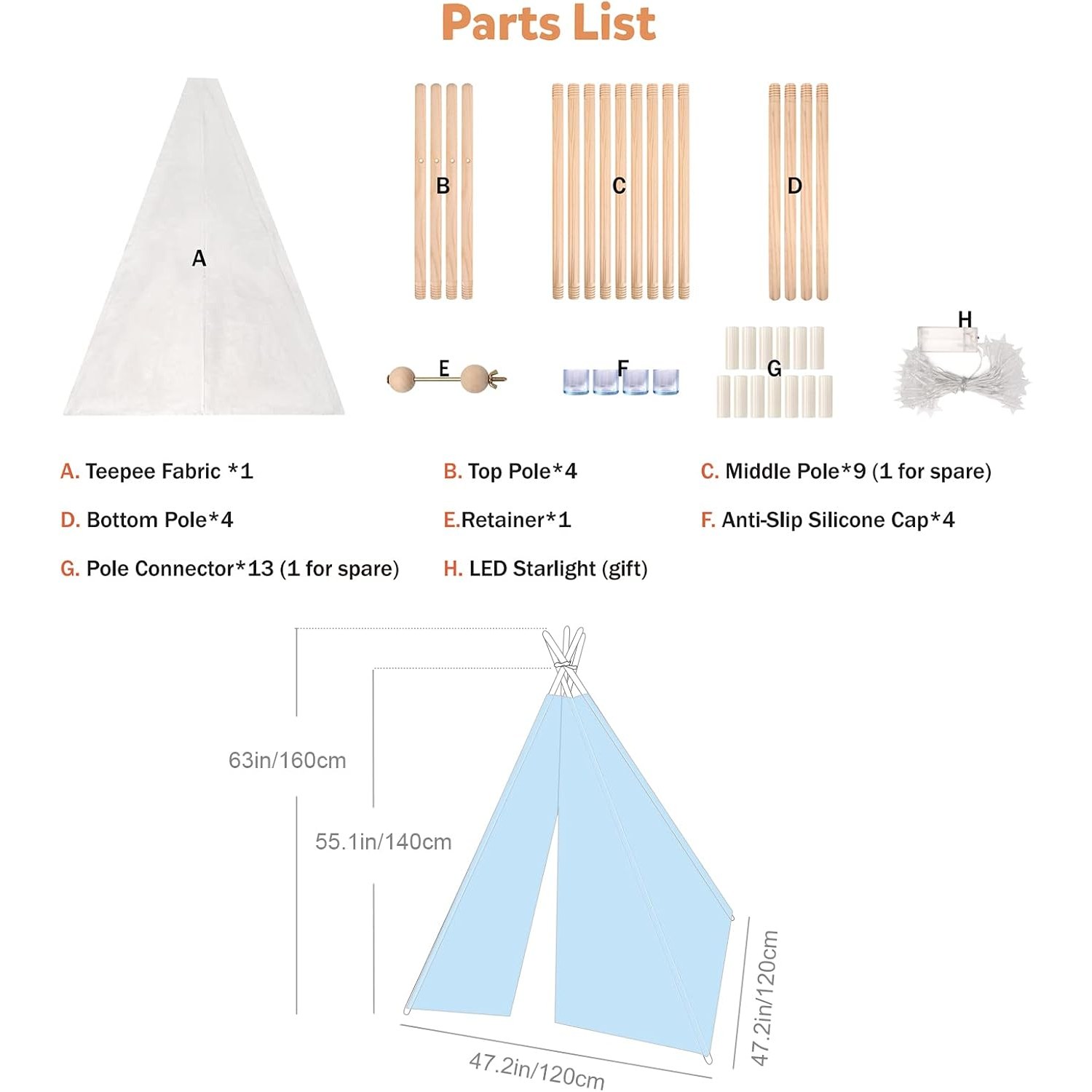
The footprint is 119.4 cm square and the peak sits at 157.5 cm. Before you order, go and stand in the corner where you imagine it going and measure the floor.
A few things to watch for. The poles splay outwards at the base, so the tent needs its full square of clear floor, not just the width of the canvas at waist height. Check that a swinging door or a wardrobe door will still clear it. Check the ceiling if the room has a sloped roof, because 157.5 cm plus a little clearance is a real constraint under eaves.
Think about what goes underneath too. Bare floorboards get cold and hard quickly, so most families put down a small rug, a padded play mat or a couple of large floor cushions. That addition is what moves it from a structure a child looks at to a spot a child uses. The best indoor play tent setups almost always involve something soft on the floor.
Finally, think about the light source. The string light is decorative. If your child is the sort who will read inside for an hour, add a small battery lamp or position the tent near a lamp you can angle in.
Setting it up
One adult can do this on their own in a few minutes. Lay the canvas out, feed each pole up into its sleeve from the bottom, bring the tops together and fit the joint. Stand it up, adjust the splay of the legs until the canvas sits evenly, and you are done.
Children usually want to help, and the job is easy enough that they can. Letting a child feed a pole into a sleeve gives them a sense of ownership that makes a real difference to whether they use the thing afterwards.
Once it is up, run your hand around the pole bases to make sure none are sitting proud of a sleeve. Give the structure a gentle push to check it holds. Then put the light on and let them in.
Looking after it
Cotton canvas and water do not need to be enemies, but they are not friends either. Spot clean marks with a damp cloth and a little mild soap, then let the fabric dry fully in the air before you fold anything. Avoid soaking the panels and avoid hot washing, because cotton canvas can shrink and a shrunk panel no longer fits the pole frame properly.
The poles want a dry or barely damp cloth, nothing more. Standing water and wood is a bad combination over time. If you have had the tent outside on grass, wipe the pole bases before it comes back indoors.
Take the batteries out of the string light if the tent is going into storage for a few months. Leaking cells inside a light set is a tedious thing to deal with.
When you do pack it down, slide the poles out and fold the canvas flat. The whole set stores under a bed or on a cupboard shelf, which is one of the quiet advantages of a canvas teepee over a rigid playhouse.
A few honest limitations
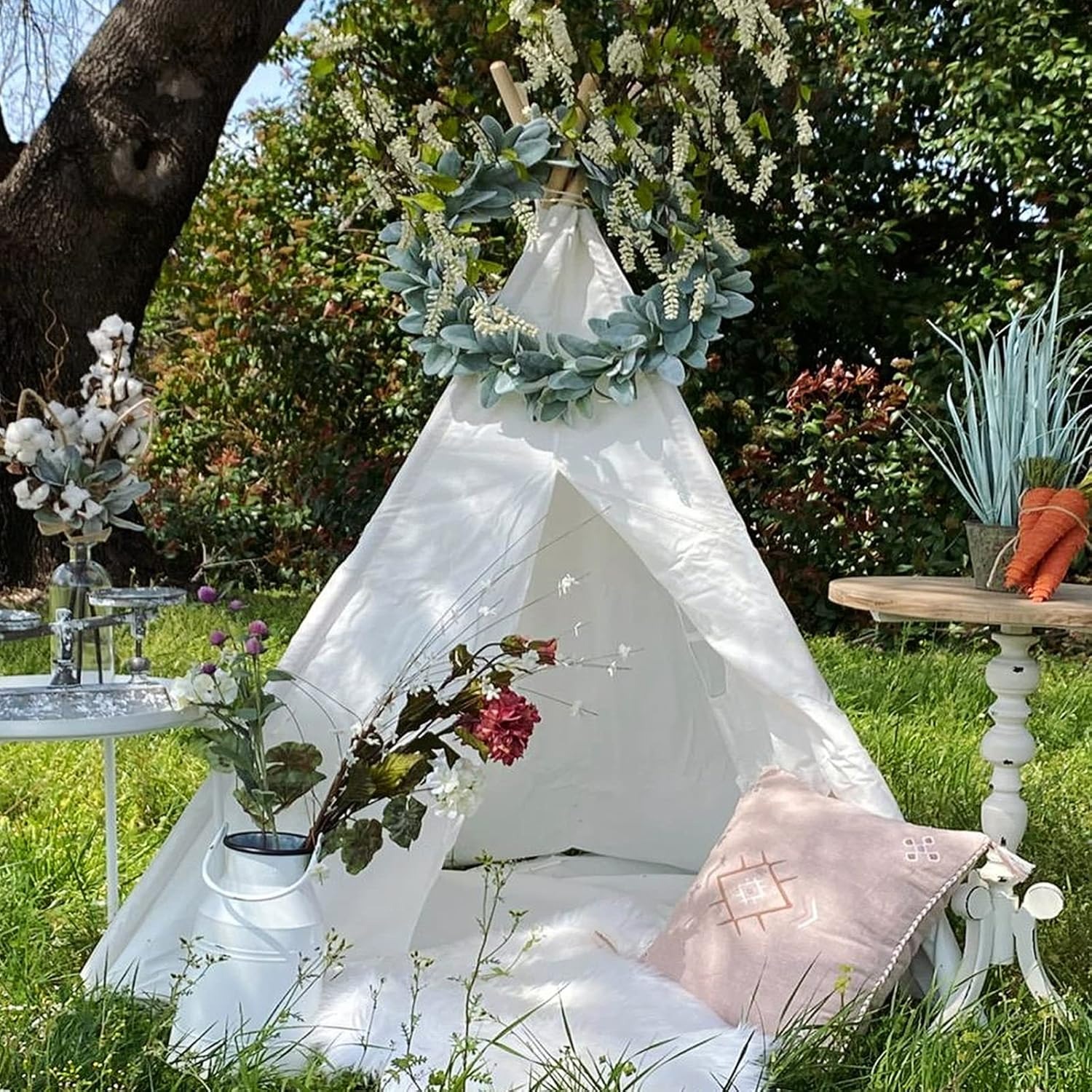
It is not waterproof. Garden use is fine on a dry day, but this is not a camping tent and should not be left out overnight or in rain.
It is not a sleeping tent. Children nap in it happily, but there is no built-in floor and no padding, so anything beyond a short nap needs bedding underneath.
The included light is soft. Lovely for atmosphere, not enough for serious reading.
And the batteries really are not included, which catches more people out on gift morning than you would expect.
The short version
This is a cotton canvas teepee on sanded pine poles, 119.4 cm square and 157.5 cm tall, with a flap door, a mesh window and a string light in the box. It goes up in minutes, folds flat for storage, and suits children from about three to twelve.
If you want to give a child a small corner that belongs to them, with a soft glow for bedtime stories and nothing sharp or complicated in the way, it does the job. Add a rug, add batteries, pick the quietest corner of the room, and let them get on with it.